
A beginner’s guide to commercial property investment
Commercial property has provided investment opportunities for generations of New Zealanders. Options range from direct property ownership to investing in shares of commercial property companies. While most Kiwis are more familiar with residential property investment, there has been increasing interest in commercial property investments over the years. Most recently, market commentators have reported a surge in interest following the announcement of new laws for residential investment. While commercial property investment is very different, there are plenty of experienced professionals ready to help. Whether you’re simply curious about investing in commercial property or keen to get started, this guide will help you understand the basics of direct commercial investments.
When you’re ready for professional advice and a commercial property loan, we can connect you with one of New Zealand’s best mortgage advisers. There’s no charge to you for their service or ours.
Why invest in commercial property?
People choose to get into commercial property for a wide range of reasons. Some are substantial investors, while others see it as a way to reduce risk by adding diversity to their investment portfolio. Many of the reasons are similar to those of residential property investors. Here are some typical examples:
As part of their retirement plan
Because their business is renting its premises and they’d prefer to own their own
To achieve a better long-term return than is currently available through other investments
To avoid having all their funds in one type of investment
To avoid the increasingly regulated residential rental market
Because they find commercial real estate interesting
The opportunity for capital growth as well as strong cash returns
Commercial property ownership entities
If you’re planning to buy a commercial property, it pays to get experienced advice on the best ownership structure for your goals. You don’t have to go it alone; teaming up with others may get you into a more profitable or lower risk commercial property venture. The various options offer different risk profiles, flexibility, financial obligations, tax regulations, personal accountability and so on. Commercial property ownership models in New Zealand include:
Individuals
Companies
Trusts
Partnerships
Syndicates
Types of commercial property
Just as a residential property investor might purchase an apartment, home unit, town house, family home or build-to-rent development, there are various types of commercial real estate to consider. Each type has its own market forces and risk vs return profile. The main groups to consider are:
Heavy industrial – factories, distribution centres and large warehouses, typically located on the outskirts of a city or town
Light industrial – usually a workshop or small warehouse with a showroom and/or reception at the front
Retail – a multi-storey building or mall, a block of shops or an individual property, either on the street or within a retail complex
Offices – anything from a small property to a building that’s designed for office workers; these sometimes include retail space on the ground or lower floors
Short-stay accommodation – motels in a wide range of sizes, rural pubs, serviced apartments backpacker lodges, hotels and luxury retreats
There’s considerable value in the lease
Commercial property is often sold with an existing lease and tenant (leasee). The quality of the lease has a strong influence on the property’s market value.
Commercial property investors consider:
The property’s yield – how much rent it earns per year as a percentage of its purchase price
The agreed process for rent reviews and whether they can drop below the original amount
How long until the lease expires and whether the tenant has a right of renewal, which is an advantage for the tenant
The reliability of the tenant and stability of their business
Whether the tenant has provided a personal guarantee
The list of chattels – what belongs to the property owner and what doesn’t
Comparing commercial and residential property investment
Most people are more familiar with residential property investment, so here’s a summary of the main differences with commercial property:
Interest paid on a commercial property mortgage or loan is a legitimate business expense for tax purposes
Capital gain on commercial property is not taxed, even if you sell within 10 years
Most commercial lease agreements are long term, typically extending for years
The Residential Tenancies Act does not apply to commercial property
The lease details everything you agree to; once signed, it’s binding
Disputes are settled in a commercial way, not through the tenancy tribunal
Default on rent payment is usually less common
Tenants typically pay for expenses, such as insurance and rates
Tenants often refurbish the building and are responsible for most interior repairs
In some commercial properties, such as a café, you may be expected to provide the fit-out
The value provided to investors is less reliant on capital gain
Banks usually require a deposit of at least 30-40% of the purchase price for a commercial property
Commercial mortgage interest rates are higher and depend on the lender’s assessment of the financial risks
Commercial mortgage loan terms are shorter, requiring earlier repayment
The return on commercial property is usually higher than residential property of the same value, especially when you take the expense payments into account
Capital gain vs capitalisation rates
Capital gain (growth) refers to the increase in a property’s value, as opposed to the income you receive from it through rent. It’s the difference between how much you paid for the property and how much you eventually sell it for.
Long-term investors focus on capital gain, as this is the way to build wealth through property investment. However, you still need the property to earn enough income to meet the mortgage repayments and other expenses, otherwise it can all unravel. It’s about finding a suitable balance between growth and yield.
Since the value of commercial property is also about the rental income it produces, commercial investors need a way to compare one property’s yield with another. Known as the capitalisation rate, or cap rate, it measures the annual rental income as a percentage of the sale price.
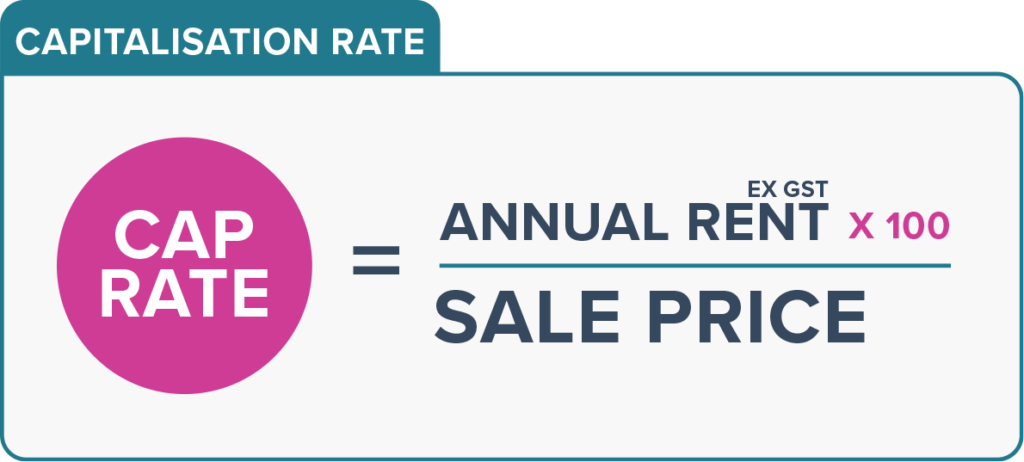
For example, if the annual rent is $50,000 ex GST on a $1m property, it has a cap rate of 5%.
What is a good cap rate for commercial property investment?
This is different for every property. It hinges on the risks associated with the property’s location, lease and tenant, as well as current investor demand. By doing some research and talking with an experienced professional, you’ll soon get a good idea of typical cap rates for the type of property you’re interested in. In the meantime, here are some scenarios that explain what can influence the rates.
Where the risk is low, a lower cap rate is more acceptable. High demand (competition) from other investors will also mean a lower cap rate is more widely accepted.
Low cap rate scenario
Popular inner city location
Big brand or international tenant
15-year lease with renewal rights
High market demand for commercial properties
Where the risks are higher, investors will expect a higher cap rate to compensate. Less demand from other investors, when the market is normal or slow, will also see cap rates rise.
High cap rate scenario
Remote location that’s not a business hub
Start-up business, local sole trader tenant
Two-year lease with renewal rights
Low-to-normal market demand for commercial properties
Deciding when to buy
Commercial property is typically a long term investment. Like most investment types, the values and yields will fluctuate with time.
It’s usually less about choosing when to buy than simply making a well-planned start and holding a property for as long as possible. It’s often said that time in the market is more important than timing the market.
When tenant demand is low or businesses are generally struggling, purchase prices will typically be lower. However, you’ll need to allow for the increased likelihood of having no rental income for an extended period if the tenant defaults on their lease.
When tenant demand is high, businesses are doing well and commercial property is selling quickly, purchase prices will typically be higher. So you’ll need to ensure you don’t borrow too much and be forced to sell at a time when prices are low.
The process for buying commercial property
Some commercial property investments may need a seismic evaluation to assess their earthquake strength. The evaluation usually starts with an initial evaluation procedure (IEP). This may indicate the need for a detailed engineering evaluation (DEE), which describes the strengthening work required and associated costs.
The %NBS is an important measure that compares the building to a similar new one in the same location, in terms of protecting life. It’s reported as a percentage of the new building standard (NBS), with more than 67%NBS being the ideal level. Above 67%NBS, a building is considered to be an acceptable seismic risk by the New Zealand Society for Earthquake Engineering.
On the overall scale, a 67%NBS is described as a medium relative risk. It indicates the risk to life is five times that of a new building and a 6% probability over 12 years of an earthquake causing the building to exceed its defined capacity. This does not mean fatalities or total collapse would occur. It also gives no indication of the likely damage or whether the building could be used again. Do your due diligence.
Commercial property managers
If you don’t have the time, confidence or inclination to take care of the day-to-day management of your commercial investment property, you could pay a property manager to do it for you. This can also be a good option if you partnered with others to buy the property. It’s a quick solution to who’s responsible for what and how they’ll be compensated for their time and effort.
A commercial property manager will typically take charge of these tasks and responsibilities:
Conduct regular property inspections
Organise building compliance checks
Arrange for maintenance that’s the owner’s responsibility
Ensure the rent is paid
Provide tenants with invoices for expenses and ensure they’re paid
Negotiate and document rent reviews and renewals
Source and check new tenants
Manage new leases
Provide a contact person for legal, accounting and real estate professionals
Financing a commercial property investment
Commercial property mortgages are more conservative and expensive than their residential investment property equivalents. The deposit required for a commercial property investment (new-build or existing) is higher than the deposit required for a new-build residential investment property, but similar to the deposit required for an existing residential property. Commercial property lenders also charge a higher interest rate and offer a shorter time to repay the loan.
When shopping for a lender, you might find that some of your front-of-mind choices aren’t interested in lending for commercial property investments. A smart strategy is to seek professional advice from a commercial mortgage broker. You’ll get advice and assistance that’s specific to buying commercial property, plus you’ll gain access to a pool of lenders that specialise in commercial investment property loans. Alternatively, look for banks that advertise commercial property lending on their websites.
The deposit required for a commercial property mortgage is usually around 30-35% of the purchase price. That means a lender will only finance up to 65-70% of the property’s value.
Commercial property loan interest rates are higher than residential rates. They’re advertised as a base rate plus a margin. The size of the margin depends on the lender’s assessment of the risk level. The more risk, the higher the margin. To estimate the risk involved, lenders consider the same risk factors mentioned above. The big two are the quality of the lease and the tenant, this includes their likely strengths in the future based on the type of property, location and other factors. Once again this highlights the value of the lease and tenant. If you can afford a property where these are typically strong, you’ll usually pay a lower interest rate.
Commercial mortgage terms are usually between 10 and 15 years, much shorter than the 25-30 years available for residential home loans.
Frequently asked questions
Here are the answers to some common questions not covered above.
How much does commercial real estate appreciate per year?
Obviously this will depend on the type of commercial property, its location, the overall economy and market demand. It also depends on the property’s lease. If the tenant changes to one with higher risk or the rent is reduced to avoid ongoing vacancy, then the value of the property can be negatively affected. On the flip-side, a new lower risk tenant and steadily rising rent are likely to improve a commercial property’s value. Over the past decade, commercial property has experienced more modest capital gains than the dramatic increase we’ve seen in residential property values. However, the return on investment or yield (excluding management fees, rates etc.) is higher for commercial property.
When investing, where’s the best location for commercial property?
This will depend on your investment strategy, particularly your appetite for risk. Quality locations, such as in a major city CBD or a sought-after industrial area, will offer lower yields but a lower risk of vacancy or rent default. This may result in a lower mortgage interest rate margin. They will also command higher purchase prices, but are more widely considered a better long-term option if you can afford them.
Can you live in a commercial property?
All buildings are designed and approved for a specific use and have to meet the related building code requirements. If you want to change a building’s use, you have to get written approval from the local council. You may have to make alterations to ensure it’s safe for the intended new use. Depending on the nature of the alterations, you might require a building consent and could instigate a requirement to bring other parts of the building up to code. Changing a building’s use from a workplace to a place where people sleep, or adding sleeping as a use, increases risk to life. The council will assess the building and let you know if any changes are required. It’s an offence to change the use without getting approval from the local council. If you’ve made alterations without approval you may have to re-do them. A change of use can also affect your insurance cover.
What happens when a tenant can’t pay due to circumstances related to Covid-19?
Tenancy Services offers guidance that may help if a tenant is having difficulty paying rent due to the impacts of a pandemic. Generally, the approach is to keep lines of communication open, be kind and negotiate a deal that works for both parties. Tenancy Services also offers advice about property repair following a natural disaster.
What is a typical yield for commercial property in NZ?
This varies considerably, but around 5% is common for commercial property, compared to something like 3% for residential rental property.
How is commercial property valued?
A specialist commercial property valuer will consider two things:
The first uses the capitalisation rate formula (mentioned above) to calculate an indicative sale price. So, 100 times the current annual rent ex GST is divided by the typical cap rate for similar buildings in comparable locations.
The second is a valuation of the land plus improvements (including the building). The land value is based on the typical square metre rate for similar properties. The value of the improvements is based on replacement cost minus depreciation.